

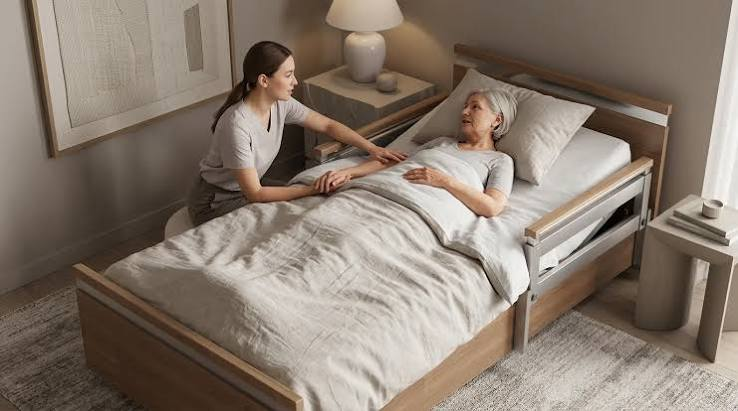
When a family member is discharged from a hospital and continuing recovery at home, one of the most consequential decisions a caregiver faces is what kind of bed to bring into the home. This is not a straightforward furniture decision. It is a clinical and logistical choice that affects the patient’s healing process, the caregiver’s ability to provide safe assistance, and the overall structure of daily life in the household for what could be weeks or months.
Hospitals discharge patients earlier than they once did, and home care has become a legitimate extension of clinical recovery for conditions ranging from post-surgical rehabilitation to stroke recovery, fracture healing, and chronic illness management. The environment in which a person rests and sleeps plays a direct role in recovery outcomes. A bed that does not support the right positioning, does not allow for safe repositioning by a caregiver, or does not adapt to a patient’s changing physical state can slow recovery, increase discomfort, and raise the risk of secondary complications such as pressure injuries or falls.
Choosing the right hospital bed for home use requires understanding what these beds actually do, how different configurations serve different patient needs, and what practical considerations matter most when moving from a clinical setting into a residential one.
Understanding What Hospital Beds Actually Provide
A hospital bed is not simply a bed with adjustable height. It is a purpose-built system designed to support patients who spend extended periods lying down, require positioning changes throughout the day, need assistance from caregivers, or have specific medical needs that a standard mattress cannot address. For families entering this decision for the first time, the range of available options and specifications can be disorienting without a clear framework.
The most practical starting point is to review a structured Hospital Beds For Sale guide that outlines bed types, configurations, and the clinical scenarios each is suited for. This type of resource helps caregivers understand what they are comparing before they begin evaluating individual products or rental agreements.
Hospital beds for sale on the consumer and home-care market generally fall into three functional categories: manual beds, semi-electric beds, and fully electric beds. The differences between these categories are not merely about convenience. They determine how much physical effort the caregiver must exert to reposition the patient, how independently the patient can adjust their own position, and how quickly positioning can change in response to discomfort or medical need.
Manual vs. Electric Configurations and Why It Matters
Manual hospital beds require a caregiver to use hand cranks to adjust the head angle, foot angle, or overall height of the bed. For patients who are largely independent and simply need a stable sleep surface with basic adjustability, this can be a reasonable and cost-effective option. However, for patients who need frequent repositioning, who are recovering from surgery that affects their mobility, or who live alone with limited caregiver availability, manual beds place a significant physical burden on whoever is providing assistance.
Semi-electric beds motorize the head and foot sections but leave the overall bed height on a manual crank. This is a common choice for home care because it addresses the most frequent adjustment need — patient position — while remaining more affordable than a fully electric model. Fully electric beds motorize all adjustments including height, which matters considerably for caregiver safety. Repeatedly bending over a low bed to assist a patient is one of the most common causes of caregiver back injuries. A bed that can be raised to a working height for care tasks and then lowered for patient safety reduces that risk meaningfully over time.
Matching Bed Features to the Patient’s Specific Condition
The medical context of the recovery determines which bed features are most relevant. A patient recovering from a hip replacement has different positioning needs than someone managing congestive heart failure, and both differ from a patient dealing with a progressive neurological condition. Understanding this connection between condition and bed function prevents the common mistake of either over-purchasing features that will never be used or under-specifying a bed that cannot support the patient’s actual needs.
Positioning Requirements for Different Recovery Types
Post-surgical patients often need the ability to elevate the head of the bed to reduce swelling or to make eating and breathing more comfortable. Cardiac and respiratory patients frequently need to sleep with the head elevated at a consistent angle throughout the night, which is difficult to achieve with standard pillows and nearly impossible to maintain through natural sleep movement. A hospital bed that holds a set angle reliably addresses this without requiring the patient or caregiver to make constant adjustments.
Patients with limited mobility or those who spend the majority of the day in bed face a different concern: pressure injury prevention. The Centers for Disease Control and Prevention recognizes pressure injuries as a serious and preventable complication in patients with reduced mobility. The choice of mattress system paired with the hospital bed is central to managing this risk. Pressure-redistributing mattresses, including foam alternating-pressure and low-air-loss systems, are designed to work with hospital bed frames, not standard bed frames. Choosing a bed frame that accommodates the correct mattress type is as important as choosing the frame itself.
Caregiver Access and Physical Safety
Most of the attention in hospital bed selection focuses on patient comfort, but the physical demands placed on caregivers deserve equal weight. Home caregivers — whether family members or hired professionals — perform tasks like turning patients, changing bed linens, assisting with personal hygiene, and repositioning limbs. These tasks are significantly safer and more sustainable when the bed can be raised to a height that keeps the caregiver’s back in a neutral position.
Side rails are another feature that affects caregiver safety and patient safety simultaneously. Full-length side rails can assist patients in repositioning themselves by providing something to hold, but they also carry fall risk if a patient attempts to climb over them. Split rails, which cover only half the bed length, provide repositioning support on the upper portion of the bed while leaving the lower portion open for easier exit. The right configuration depends on the patient’s cognitive status, their level of independence, and whether fall prevention or mobility assistance is the primary concern.
Practical Considerations Before Purchasing or Renting
Hospital beds for sale are available both as direct purchases and as rental agreements, and the choice between these models should be based on the expected duration of recovery. For short-term recovery periods — typically fewer than three months — rental is usually the more practical option. It eliminates the need to manage equipment after recovery is complete and often includes delivery, setup, and basic maintenance as part of the agreement. For long-term or indefinite care needs, purchasing a bed may represent better value and allows for equipment customization that rental fleets may not accommodate.
Home Environment Assessment
Before any hospital bed is ordered, the physical space where it will be placed needs to be assessed honestly. Hospital beds are wider and longer than most twin or full mattresses, and they require clear space on at least three sides for caregiver access. A bedroom that is sized around a standard double bed may require furniture rearrangement or removal to safely accommodate a hospital bed. Doorways also matter — hospital beds in their lowest, folded configuration still need to pass through standard interior doorways during delivery and setup, and this is occasionally an issue in older homes with narrower openings.
Power access is a straightforward but frequently overlooked consideration. Electric hospital beds require a grounded outlet nearby. Extension cords are generally not recommended for medical equipment due to trip hazard and power fluctuation concerns. Confirming outlet placement relative to the intended bed position before delivery avoids installation complications on the day of setup.
Insurance and Equipment Coverage
In many cases, hospital beds qualify as durable medical equipment under health insurance plans, including Medicare and some private insurance policies. Coverage typically requires a physician’s written order specifying the medical necessity of the equipment. Without this documentation, the cost falls entirely to the family. Caregivers should confirm with both the patient’s physician and their insurance provider before finalizing a purchase or rental, because the paperwork requirements vary by insurer and the approval process can take time that affects discharge planning.
Working with Healthcare Providers on Equipment Selection
The patient’s care team — particularly the discharge planner, occupational therapist, or home health nurse — can provide specific guidance on which bed configuration best suits the patient’s clinical picture. Discharge planners in hospital settings regularly work with home medical equipment suppliers and can often provide referrals to vendors who specialize in home hospital beds for sale with appropriate setup and support services.
Occupational therapists are particularly useful in this process because their training centers on how patients function within their actual living environments. They can assess whether the patient will be able to operate bed controls independently, identify positioning needs specific to the patient’s diagnosis, and flag home environment issues that might affect which bed type is most practical. Involving an occupational therapist in the equipment decision, even for a single consultation, tends to result in better equipment choices and fewer adjustments after discharge.
Concluding Thoughts
Choosing the right hospital bed for home recovery is a decision that sits at the intersection of medical need, caregiver capacity, and household practicality. It is easy to underestimate because it looks like a purchasing decision when it is actually a care planning decision. The bed configuration affects how safely and comfortably a patient can rest and be cared for over the duration of their recovery, and the right choice looks different depending on the diagnosis, the home environment, the caregiver’s physical capabilities, and the expected recovery timeline.
Families who take time to understand what hospital beds for sale actually offer — beyond adjustable height and rails — are better positioned to select equipment that holds up through the demands of real home care. Consulting with the patient’s medical team, reviewing detailed product comparisons, assessing the home environment in advance, and confirming insurance coverage before purchase are all steps that reduce the likelihood of needing to replace or supplement equipment after the patient is already home.
Recovery at home is demanding for both patient and caregiver. The right equipment does not make it easy, but it removes unnecessary friction from the process — and over the course of a long recovery, that matters considerably.
