

Choosing a health insurance plan is rarely a straightforward decision, and that difficulty compounds when you factor in regional variables like available provider networks, local hospital affiliations, and the specific healthcare infrastructure of a mid-sized city like Denton, Texas. Denton sits in a unique position — large enough to have its own medical facilities and specialist ecosystem, yet close enough to the Dallas-Fort Worth metroplex that many residents regularly cross city lines for care. That geographic reality matters more than most people realize when selecting between plan types.
Most people approach this decision by comparing premium costs, which is understandable but incomplete. The plan structure itself — how it handles referrals, which providers it covers, what it requires of you administratively — determines how well a plan functions in real life. HMO, PPO, and EPO plans are fundamentally different in design, not just in price. Understanding those structural differences, rather than treating them as minor variations of the same product, is what allows someone to make a genuinely informed choice.
How Plan Type Determines the Way You Access Care in Denton
When evaluating health insurance denton residents need to consider more than the monthly premium listed on an enrollment page. The plan type dictates whether you need a referral to see a specialist, whether care received outside the plan’s network carries any coverage at all, and how much administrative coordination falls on you versus the insurance structure itself. These factors directly affect how you experience the healthcare system, especially in a city where patients frequently move between Denton-based providers and DFW specialists.
For those researching local options, resources like health insurance denton can provide a clearer view of what plan structures are actually available in the area, which helps ground these comparisons in local reality rather than general theory.
The three plan types — HMO, PPO, and EPO — share some surface-level similarities but diverge significantly in how they handle out-of-network care, primary care coordination, and cost distribution. Understanding each one individually, before comparing them, produces clearer thinking about which structure fits a given situation.
Why Network Design Is the Core Distinction
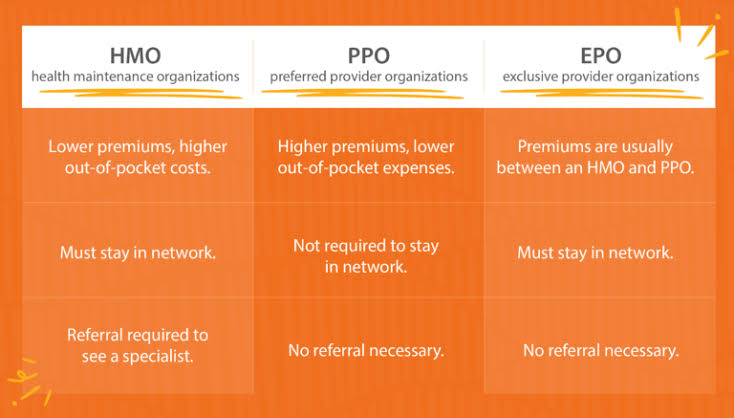
Each of these plan types is built around a different philosophy of network management. HMOs operate on the assumption that coordinated, in-network care is the most efficient and cost-controlled model. PPOs operate on the assumption that flexibility and access to a broader provider pool justify a higher premium. EPOs sit in between — offering some of the cost structure of an HMO while removing the primary care gatekeeper requirement, but with strict network boundaries similar to an HMO.
In a city like Denton, where the medical ecosystem is growing but not yet as dense as major metropolitan centers, network design has practical consequences. A plan with a narrow HMO network might not include every specialist a patient needs locally, requiring either a referral process or a trip to a DFW provider. A PPO might cover that DFW specialist directly, but at a cost premium that accumulates over time. These are not hypothetical trade-offs — they are operational realities that affect real decisions about care.
HMO Plans: Structured Access and Cost Predictability
Health Maintenance Organizations require members to select a primary care physician who then acts as the central coordinator for all medical care. This means that accessing a specialist typically requires a referral from that primary care physician, and care received outside the plan’s approved network is generally not covered at all, except in documented emergency situations. The model is built around tight coordination rather than open access.
For Denton residents with stable, predictable healthcare needs — those who primarily use preventive care, manage one or two ongoing conditions, and have an established relationship with a local primary care provider — an HMO can function very well. The administrative requirements are higher in the sense that you cannot self-refer, but the cost structure is typically the most affordable of the three options, with lower premiums and predictable out-of-pocket costs.
When the HMO Model Creates Friction
The HMO model begins to create difficulty when a patient’s healthcare needs require specialist involvement across multiple disciplines, or when the specialists they need are not part of the plan’s local network. In a city like Denton, which has experienced rapid population growth, the local specialist network may lag behind demand in certain areas of care. If a patient needs a cardiologist, oncologist, or subspecialist not well-represented in the local HMO network, the referral and authorization process can delay care or require appealing for out-of-network exceptions.
The coordination requirement can also create friction for working adults who have limited time to manage the referral process, particularly when dealing with time-sensitive diagnoses. This is not a flaw unique to any single insurer — it is a structural characteristic of the HMO model that applies consistently across plans of this type.
PPO Plans: Flexibility With a Premium Cost
Preferred Provider Organizations give members significantly more freedom in how they access care. There is no requirement to select a primary care physician, no referral process for specialists, and the plan provides some level of coverage even for providers outside the network, though typically at a reduced reimbursement rate. This flexibility is the defining characteristic of the PPO and the primary reason its premiums tend to run higher than HMO options.
For Denton residents who frequently access care in the DFW area — whether due to work location, specialty needs, or personal preference — a PPO can justify its cost difference by eliminating the gaps that a more rigid network might create. The ability to see a specialist in Frisco, Plano, or Dallas without needing prior authorization, and with some level of coverage intact, is a meaningful operational benefit for certain patients.
Understanding the Cost Trade-Off Over Time
PPO plans shift cost management responsibility to the member. Because the plan accommodates a broader range of providers and requires less administrative gatekeeping, the member pays more in premiums to sustain that flexibility. For individuals or families in good health who rarely use the system, this can mean paying for flexibility they never actually need. For individuals with complex or ongoing health situations who genuinely use that broader access, the premium difference may be warranted.
The important calculation is not the monthly premium in isolation but the total anticipated annual spend, including premiums, deductibles, copays, and the likelihood of needing out-of-network care. According to the Centers for Medicare and Medicaid Services, plan selection decisions that account for both expected and unexpected utilization tend to produce better financial outcomes than decisions made on premium alone.
EPO Plans: A Middle Structure With Strict Boundaries
Exclusive Provider Organizations occupy a structural position between the HMO and the PPO. Like an HMO, an EPO provides no coverage for out-of-network care in non-emergency situations. Like a PPO, it typically does not require a primary care physician designation or a referral process to access specialists. Members can go directly to any in-network specialist without prior authorization, but they must stay within the plan’s defined network to receive any coverage at all.
This combination can appeal to people who want some autonomy in how they access care but are comfortable staying within a defined network. For Denton residents whose regular providers — including any specialists they use — are already within the EPO network, this plan structure can offer a reasonable balance between cost and access. The risk is that it provides no fallback for out-of-network situations, meaning a single out-of-network visit, even for something that feels minor, results in full out-of-pocket cost.
The Risk of Assuming Your Providers Are In-Network
One of the more consistent practical problems with EPO plans is the assumption that providers are in-network without verifying it explicitly before each visit. Physician groups, hospitals, and individual providers update their network participation status periodically, and a provider who was in-network at enrollment may not remain so throughout the plan year. For EPO members, this carries a higher consequence than for PPO members, because there is no partial coverage to cushion an out-of-network charge.
Denton residents considering an EPO should take the time at enrollment to verify not just that their current providers participate in the network, but that the local facilities they would use in an urgent or complex situation are also in-network. This is particularly relevant for hospital-based care, where the facility may be in-network but specific physicians — anesthesiologists, surgical assistants, hospitalists — may not be.
Matching Plan Structure to Your Actual Situation in Denton
The right plan type is determined by a combination of factors that are specific to each person’s circumstances: how frequently they use healthcare services, whether they have established provider relationships, whether their work or family situation requires access across multiple cities, and how much administrative complexity they are willing to manage. None of the three plan types is universally superior — each is designed for a different pattern of use.
Someone who is generally healthy, has a trusted primary care physician within a local network, and rarely needs specialist care will likely find an HMO to be the most practical and affordable option. Someone managing a chronic condition requiring multiple specialists, or whose work keeps them across different parts of the DFW area regularly, may find the PPO’s flexibility worth its cost. Someone who wants direct specialist access without a referral layer, and whose providers are solidly within a defined local network, may find the EPO to be the appropriate balance.
The key is to evaluate these plans based on actual usage patterns rather than theoretical flexibility or the lowest visible premium. When people choose plans based on upfront cost alone without accounting for how they realistically use healthcare services, they tend to encounter structural limitations mid-year that are difficult to work around until the next enrollment period.
Conclusion: Structure First, Cost Second
The HMO, PPO, and EPO distinction is not a matter of one plan being better than the others in any absolute sense. Each reflects a different model for organizing access, managing cost, and distributing responsibility between the insurer, the primary care system, and the member. For Denton residents evaluating their options, the most useful approach is to begin with structure — understanding what each plan type requires of you and allows you to do — before moving to cost comparisons.
Denton’s position as a growing city with its own healthcare infrastructure, combined with its proximity to the DFW metroplex, means that network design and access patterns are genuinely consequential in ways that may not apply equally in larger metro centers with denser provider availability. A plan that works well for a Dallas resident may not function the same way for someone whose primary care and specialist relationships are rooted in Denton.
Taking the time to map your existing provider relationships, your likely utilization patterns, and your tolerance for out-of-pocket variability against the structural characteristics of each plan type will produce a more durable decision than any comparison of premiums alone. That groundwork, done before enrollment rather than after a coverage gap appears, is what separates a plan that works from one that merely looks affordable at the start.
