

Introduction
When a cat has chronic kidney disease (CKD), its care may involve several areas of health, including appetite, hydration, blood test results, and general comfort. Some cats with CKD may also develop non-regenerative anaemia. This is a condition in which the body does not make enough new red blood cells to replace those that are lost or removed. Understanding the difference between kidney disease itself and related conditions can help owners have clearer conversations with their veterinary team. It also makes it easier to understand why a veterinarian may consider a specific medicine as part of an individual care plan.
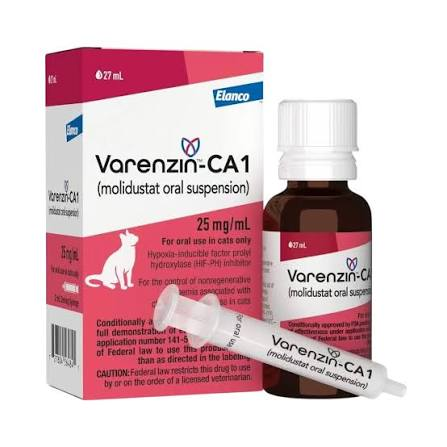
Varenzin-CA1 is a veterinary medicine containing molidustat. It is supplied as an oral suspension and is intended for cats. It is important to recognise that this product is not a general kidney supplement or a treatment for every sign of kidney disease. Its labelled purpose is more specific: the US product information identifies it for the control of non-regenerative anaemia associated with chronic kidney disease in cats. Owners researching this medicine should read the exact product details, understand its intended use, and discuss its suitability with a veterinarian before taking any next steps.
What Is Varenzin-CA1?
Varenzin-CA1 contains molidustat sodium, an ingredient classified as a hypoxia-inducible factor prolyl hydroxylase (HIF-PH) inhibitor. In simple terms, this type of medicine acts on a pathway involved in the body's response to oxygen levels. That pathway is connected with the production of erythropoietin, a hormone that helps signal the body to make red blood cells. This is relevant because the kidneys play an important role in normal erythropoietin production, and chronic kidney disease can affect this process.
The official US product label describes Varenzin-CA1 as a prescription animal drug for oral use in cats only. It is conditionally approved by the US Food and Drug Administration, pending a full demonstration of effectiveness. This regulatory detail matters because approval status and product information can differ between countries. Owners should not assume that labelling, legal supply rules, or product availability are identical in every market. A veterinarian or an appropriate local regulatory source can help clarify which information applies to the product supplied in a particular location.
Understanding the Oral Suspension and Product Details
Varenzin-CA1 is an oral suspension, not a tablet or capsule. The official US label lists a concentration of 25 mg/mL and a presentation containing 27 mL in one bottle. The labelled pack includes an oral dosing syringe. These details help identify the specific product and distinguish it from other veterinary medicines that may have similar-looking names or different forms. When checking a listing, owners should compare the product name, active ingredient, concentration, bottle size, and included components rather than relying on a short product title alone.
A suspension is a liquid preparation in which the medicine is distributed through a liquid base. It should not automatically be treated like a solution, tablet, or supplement. The US label instructs that the bottle should be shaken well before use and describes the use of the supplied syringe. These are product-specific handling details, not a substitute for veterinary directions. Owners should follow the current package renal product information supplied with their own product and ask a veterinary professional if the bottle, syringe, label, or instructions do not match what they expected.
Veterinary Assessment, Monitoring, and Safe Use
A veterinarian needs to assess the cat before deciding whether Varenzin-CA1 is appropriate. A diagnosis of chronic kidney disease alone does not establish that a cat has non-regenerative anaemia or that this particular medicine is suitable. The veterinary assessment may involve the cat's history, physical examination, and laboratory results. Blood test findings can help the veterinary team understand red blood cell levels and decide whether further investigation or a specific treatment plan is needed. Owners should share information about other medicines and supplements the cat receives.
Monitoring is also an important part of treatment. The US product label includes precautions relating to changes in red blood cell levels and describes the need for regular monitoring of haematocrit or packed cell volume during a treatment cycle. It also lists safety considerations, including reported thromboembolic disease and caution for cats with a history of seizures or possible risk factors. These details are reasons to keep veterinary follow-up in place, not reasons to start, stop, or change treatment without advice. The veterinarian should explain which checks are needed and what signs should prompt a call.
Checking Product Information and Kidney-Care Options
Before ordering or discussing Varenzin-CA1, owners should confirm the exact product presentation shown on the listing. The product page for Varenzin-CA1 molidustat oral suspension is a useful place to review the named product and its available information. Pack-specific availability may need to be confirmed, so it is best not to assume that every listed presentation is immediately in stock. Check the displayed details and ask for confirmation if the bottle size, concentration, packaging, or supply status is unclear.
Varenzin-CA1 is only one type of product within the wider area of feline kidney care. The kidney and urinary care collection brings together products in this broader category, but the items may serve different purposes and should not be treated as interchangeable. A prescription medicine, a nutritional supplement, and a general care product have different roles. Owners should not combine products or replace a prescribed treatment based only on category labels or online descriptions. A veterinarian can help decide which options, if any, fit the cat's individual health needs.
Conclusion
Varenzin-CA1 is a molidustat oral suspension developed for cats, with a specific labelled use relating to non-regenerative anaemia associated with chronic kidney disease. Its product identity includes important details such as the active ingredient, liquid form, concentration, and bottle presentation. The official US label lists 25 mg/mL in a 27 mL bottle and identifies the medicine as a prescription animal drug for cats. These details are useful when checking a product listing, but owners should always confirm that the information matches the pack and regulatory market relevant to them.
The most useful next step is to discuss the cat's diagnosis, test results, and treatment options with a veterinarian. Owners can then check the exact product information and confirm pack-specific availability before proceeding. Varenzin-CA1 should not be viewed as a general cure for kidney disease, a routine supplement, or a medicine suitable for every cat with CKD. Clear product information, appropriate veterinary oversight, and regular monitoring help owners make informed decisions while keeping their cat's overall care at the centre of the process.
