

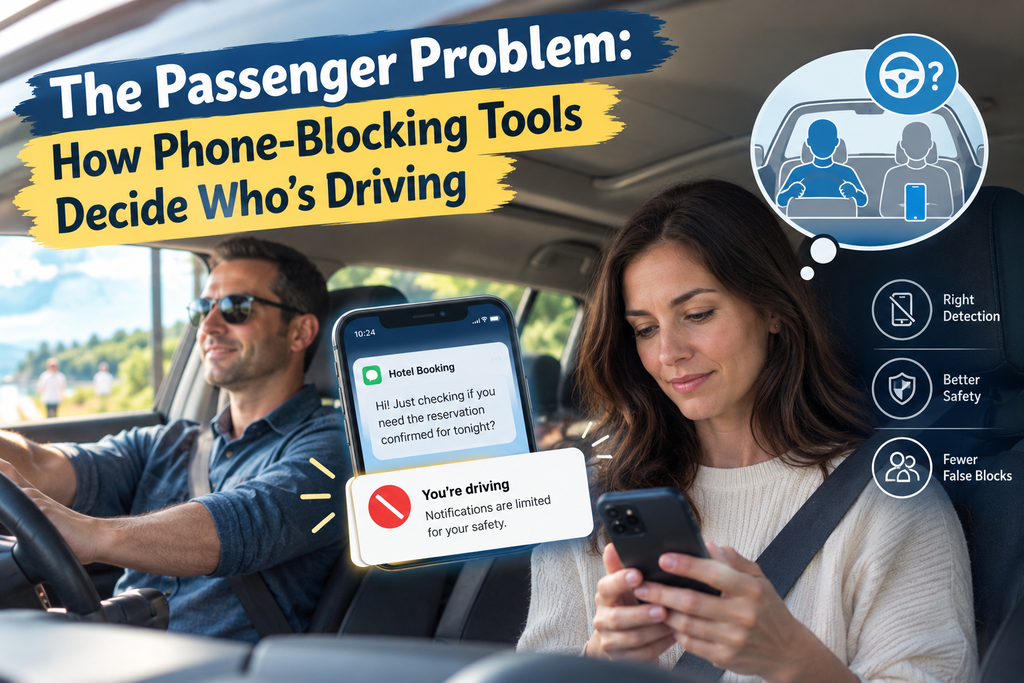
Picture a mother riding shotgun on a family road trip, trying to confirm a hotel booking by text while her phone insists she’s driving. It’s a small annoyance. It also points to a real design problem for any tool meant to curb distracted driving: the phone can tell the car is moving, but not always who is behind the wheel.
The stakes are real. NHTSA reports that in 2024, 404 fatal crashes involved a driver’s cellphone use, 14% of distraction-affected fatal crashes, and that police reports likely undercount phone involvement. GHSA, citing NHTSA’s roadside survey, says more than 537,000 US drivers are visibly manipulating a phone at any given moment in daylight.
Why a moving phone isn’t always a driver’s phone
A phone’s accelerometer and GPS can show that it’s traveling at driving speed. They can’t tell whether it’s in a driver’s pocket, a passenger’s hand or the back seat of a rideshare.
Consumer features show the problem. Apple’s Driving Focus can activate automatically based on detected motion, and Apple lets a passenger tap “I’m Not Driving” to get notifications back. On Android, Google restored a Bluetooth-based activation option on Pixel phones in February 2026, after motion-only triggering had been silencing passengers’ phones, according to Android Central and Android Authority. Both outlets are trade press, so confirm current behavior on your own device.
How systems try to tell driver from passenger
Phone-only methods
Researchers have tried using phone sensors alone. A 2013 MobiSys study (Wang and colleagues) used accelerometers and gyroscopes to compare centripetal acceleration during turns and infer whether a phone sat on the left or right side of the vehicle. It was tested in two vehicles in two cities, and it depends on the car making turns, so it can’t decide the instant a trip starts.
Adding the car
Other approaches use the vehicle. A 2011 MobiCom study (Yang and colleagues) had the phone play high-frequency beeps through the car stereo’s speakers and time their arrival. It reported classification accuracy above 90%, about 95% with calibration, and false positives in the low single digits. It was tested with two phones and two cars, and it depends on a Bluetooth-connected stereo.
NHTSA has weighed in too. Its 2016 proposed guidelines for portable devices encouraged automatic driver mode only when a device, alone or with the vehicle, can tell it’s being used by the driver, and not for passengers. NHTSA’s 2013 guidelines also acknowledged that some recommendations might require a way to tell driver from front-seat passenger. These guidelines were voluntary and proposed, not binding rules.
A vehicle-level system can know things a phone can’t, such as whether the car is actually moving. But it still has to decide which phone is the driver’s, so vehicle detection doesn’t automatically solve the passenger problem. A text blocker needs both pieces: a reliable trigger and a reliable way to choose whose phone to restrict.
What early phone-blocking systems show
Cellcontrol’s history is a useful example, as a historical case and not a picture of today’s market. Its early system used a plug-in OBD-II module plus an app to block the phone while the car moved. In 2013, Consumer Reports described DriveID, which used a windshield sensor to tell whether a phone was on the left or right side of the car. Reports at the time said a phone passed to a passenger regained full function, though Consumer Reports also noted that a rear-seat passenger sitting behind the driver was blocked too. Coverage noted the system worked for phones registered with its app and could alert an administrator about tampering.
The lesson is that position-based detection helps, but it has edge cases, and any system depends on setup, registration and cabin geometry.
Why wrong blocks matter
Adoption is the quiet safety issue. The AAA Foundation’s 2025 report, based on a survey of 300 drivers, found that better recognition of when the user is a passenger could make drivers likelier to use these features. A Cambridge Mobile Telematics survey (company research, 2023, 1,000-plus drivers) found some non-users worried about missing calls or messages, and others called the feature inconvenient. I found no study measuring how often wrong blocks lead people to switch tools off, but it’s reasonable to expect that a tool that frustrates passengers will get disabled.
Questions to ask before choosing a tool
- How does it decide driving has started? From phone sensors, Bluetooth, or vehicle signals?
- How does it choose the driver’s phone? What happens when phones are shared or passed around?
- What about passengers? Front seat, rear seat and rideshares can behave differently.
- What happens to blocked messages? Apple, for example, silences or limits notifications, and senders can flag urgent ones. Others delay or auto-reply.
- What about emergencies? Ask how 911 calls and exceptions work.
- How easily can it be disabled? Some early systems alerted administrators to tampering.
- Does it need vehicle hardware? That affects cost and compatibility.
- What data does it collect, and who sees it? NHTSA’s proposed guidelines devote a section to privacy for paired devices, which shows how central the issue is.
When comparing safe driving apps and hardware, these questions matter more than feature lists.
FAQ
Can a phone tell whether its owner is driving or riding?
Not from motion alone. Research has used turning dynamics and car-speaker signals, and commercial systems have added Bluetooth or in-car sensors. Each has limits.
Why does driving mode turn on when I’m a passenger?
If activation relies on motion, the phone can’t tell your seat. On iPhone, tap “I’m Not Driving.” On Android, check whether a Bluetooth-based option is available.
Does vehicle-level detection solve the problem?
No. It can make the trigger more reliable, but the system still has to identify which phone belongs to the driver.
What happens to messages when they’re blocked?
It depends. Apple silences or limits notifications, and messages aren’t deleted. Ask any tool how it holds, replies to or releases messages.
Conclusion
Telling driver from passenger is a design problem with no perfect answer. Motion sensing alone is easy to fool, car-based signals help, and every method has edge cases. My Drive Guardian, for example, describes its text blocking as triggered by the vehicle rather than by phone sensors alone, and says this avoids blocking a passenger’s phone by mistake. As with any tool, it’s worth asking how it identifies the right phone, and the questions above are a starting point.
