

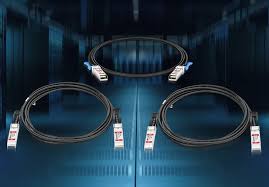
The Reality of Short-Distance Links in Modern Data Centers
When people think about high-speed networking, the discussion often focuses on optical technologies capable of reaching dozens or even hundreds of kilometers. Those technologies are certainly important, especially for connecting distributed data centers and long-distance infrastructure. But inside most data centers, the majority of connections are actually very short.
Servers are placed inside racks only a few meters away from switches. Storage nodes communicate with compute clusters located in the same cabinet or in the next rack. Aggregation switches sit nearby, sometimes within arm’s reach of each other.
In these situations, using long-distance optical modules would be unnecessary and inefficient. Optical solutions are designed to move signals across large distances, which introduces additional cost and power consumption that short connections simply do not require.
This is where 100G DAC (Direct Attach Copper) cables become extremely useful.
These cables provide high-speed Ethernet connectivity using copper conductors rather than fiber optics. Designed for interfaces such as QSFP28 ports, DAC cables allow devices to exchange 100-gigabit data across short distances with minimal complexity.
For many data center operators, they are one of the simplest and most reliable ways to build high-density networks.
How 100G DAC Cables Deliver High-Speed Transmission
Although DAC cables appear simple from the outside, their internal design is highly optimized for high-speed data transmission.
A typical 100G DAC cable integrates four high-speed data lanes. Each lane carries around 25 gigabits per second, and together they combine to deliver the full 100-gigabit Ethernet bandwidth. These electrical signals travel through carefully engineered copper conductors that maintain precise impedance and shielding characteristics.
The connectors on each end of the cable contain small electronic components that allow the host device to recognize the cable. When plugged into a switch or server port, the cable communicates information such as its length, capabilities, and supported data rates.
This automatic identification process helps ensure compatibility and simplifies installation.
Unlike optical modules that require separate transceivers and fiber cables, DAC cables combine everything into a single integrated assembly. Once both ends are connected, the link typically comes online within seconds.
For network technicians working inside crowded data centers, this simplicity can make a noticeable difference during deployment.
Deployment Inside Server Racks and Switching Layers
One of the most common places to find DAC cables is the top-of-rack architecture widely used in modern data centers.
In this design, each rack contains a switch that connects directly to all servers located within the same rack. The physical distance between devices is extremely small, often less than two meters.
DAC cables are ideal for this scenario.
They provide enough bandwidth to support high-performance applications while keeping installation straightforward. Because the cables are short, signal quality remains strong and stable.
Another deployment scenario involves connections between switches inside the same rack or between neighboring racks. Data center networks often rely on redundant switching systems to ensure high availability.
DAC cables allow these switches to exchange traffic quickly without introducing additional optical hardware.
High-performance computing clusters also rely heavily on DAC connections. When large numbers of compute nodes exchange data frequently, low latency and stable connectivity become critical.
Copper-based DAC cables often introduce slightly less latency than optical alternatives because they avoid certain signal conversion stages.
For workloads involving real-time processing or AI model training, this small advantage can help improve overall system performance.
Benefits That Make DAC Cables Popular
Several practical advantages explain why DAC cables remain common in high-speed networking environments.
First is cost efficiency. Optical modules require lasers, photodetectors, and complex signal processing components. DAC cables rely mainly on copper conductors and simple electronics, which significantly reduces cost for short-distance connections.
Second is power consumption. Passive DAC cables typically consume almost no additional power. In large data centers where thousands of connections exist, this difference can noticeably reduce energy usage and cooling requirements.
Third is ease of installation. Because DAC cables combine the transceiver and cable into one piece, technicians do not need to install separate optical modules or handle delicate fiber connectors.
They simply plug each end into the corresponding port.
This straightforward installation process speeds up network deployment and reduces the likelihood of configuration mistakes.
Finally, DAC cables tend to be very reliable in short-range environments. The absence of optical components means fewer parts that could potentially fail.
For many operators, this reliability is just as important as performance.
Limitations of 100G DAC Connections
Despite their advantages, DAC cables are designed for a very specific purpose and cannot replace optical solutions entirely.
The most important limitation is distance. Electrical signals degrade more quickly than optical signals when traveling through copper conductors. As a result, DAC cables typically support only a few meters of reach.
Most passive DAC cables operate effectively within ranges between one and five meters, though some designs can extend slightly further.
When connections must reach across larger sections of the data center, optical technologies such as active optical cables (AOCs) or traditional transceivers become necessary.
Another consideration is cable thickness. High-speed copper cables require multiple shielding layers to prevent interference, which can make them thicker than fiber cables. In dense racks with many connections, cable management may require careful planning.
Even so, these limitations rarely cause problems in the short-distance environments where DAC cables are commonly deployed.
The Continuing Role of DAC in Future Networks
As Ethernet technology advances toward 200G, 400G, and beyond, the need for short-distance connectivity will not disappear. Servers will still sit close to switches, and internal rack connections will remain only a few meters long.
Because of this, direct attach copper technology will likely continue evolving alongside faster network speeds.
Future generations of DAC cables may support higher data rates while maintaining the same advantages of simplicity and efficiency. The fundamental idea—direct electrical connections for very short links—remains extremely practical.
Even in data centers built around advanced optical fabrics, DAC cables will likely remain the preferred solution for the shortest connections.
They represent a straightforward approach to networking that fits naturally into high-density infrastructure.
Conclusion
100G DAC cables provide an efficient and reliable solution for short-distance connectivity within modern data centers. By transmitting high-speed Ethernet signals through copper conductors, they eliminate the need for optical transceivers while delivering strong performance over short ranges. Their low cost, minimal power consumption, and simple installation make them ideal for server-to-switch and intra-rack connections. Although they cannot replace optical technologies for long-distance links, DAC cables continue to play an essential role in building scalable and high-density network architectures.
