

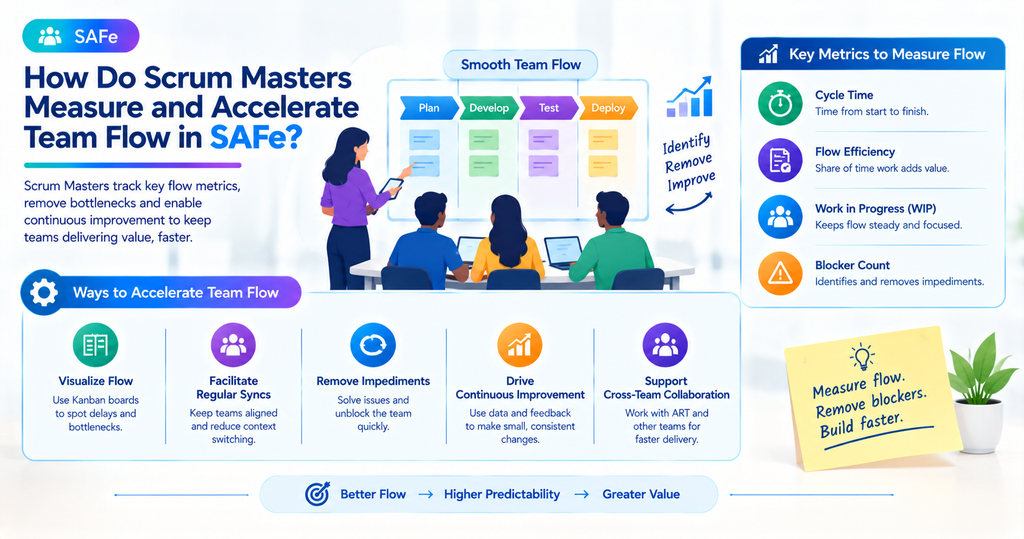
Delivering more work in a certain time period does not necessarily mean delivering more value, especially in an SAFe environment. A workflow can be fast, without necessarily improving delivery quality, due to hidden impediments, process defects, and delays.
The Scrum Master is responsible for understanding how exactly work flows through the team and identifying possible blockers and impediments that prevent customers from receiving valuable outcomes.
SAFe defines flow as the smooth transition of work through a value stream while cutting down on hindrances like delays, handoffs, reworks, and queues.
What Is Team Flow in SAFe?
Team flow talks about how effectively an Agile Team transitions from working on an initial idea, work item, or request towards a completed and valuable outcome.
In SAFe, the Scrum Masters help manage this flow by removing impediments, encouraging self-management, and facilitating continuous improvement. For Scrum professionals looking to strengthen this ability, enrolling in SASM Certification training can be beneficial. It can also provide structured knowledge on advanced Scrum Master practices.
Having a good team flow does not mean that all team members need to be assigned work continuously. It actually means ensuring that work moves continuously through different work phases without unnecessary multitasking and delays while also ensuring that the output remains valuable.
Sometimes, although a team might appear to be highly productive, they might be suffering from too much works in progress (WIP), frequent interruptions, an overwhelming amount of dependencies, and long queues. To tackle this, Scrum Masters ought to measure their workflows to make hidden problems visible.
Key Metrics Scrum Masters Can Use
SAFe identifies six types of flow metrics to help Scrum Masters get a better view of how effectively work moves through a system.
1. Flow Distribution
Flow distribution refers to the amount of time and resources that are spent across different work items moving through the workflow. This can help a Scrum Master understand whether a team is spending too much effort on technical work, new features, defects, or other activities.
For example, a sudden focus and an increase in unplanned events may lead to planned objectives constantly being missed.
2. Flow Velocity
Flow velocity refers to the number of backlog items that are completed during a specific time period. This measure helps Scrum Masters understand a team’s delivery pattern and recognize changes in the team’s output. However, velocity should be used for forecasting and planning, not as a score chart for how productive a team is.
3. Flow Time
Flow time determines how long it takes for a work item to move through the workflow. An increased flow time can indicate growing dependencies, queues, unclear requirements, and bottlenecks. When these patterns are tracked over time, over multiple iterations, it gives Scrum Masters enough information to facilitate improvement discussions with teams to understand how to address these hindrances.
4. Flow Load
“Flow load” refers to the amount of work currently in progress. Too many WIPs lead to longer completion times and frequent context switching. A good way to prevent this and accelerate workflow is to limit the WIP in a team’s pipeline. Scrum masters can encourage their team to address the work items already in the flow before they consider working on a new item.
5. Flow Efficiency
This metric compares the active work time with the total elapsed time. For example, if a story is supposed to take ten days to complete but only receives two days of actual, value-adding work time, the remaining time represents delays like queues, dependencies, and waiting.
Flow efficiency helps teams examine the actual amount of time spent in moving work items through the workflow.
6. Flow Predictability
Flow predictability compares how consistently a team delivers quality outcomes with respect to the planned outcomes. Scrum Masters can use it to identify unrealistic planning assumptions, dependencies, and recurring interruptions.
How Can Scrum Masters Accelerate Team Flow?
Measuring is just one part of making workflows efficient. Workflows truly become effective when the data produced from the measurements is used to remove hindrances.
Visualize and Limit WIP
By using tools such as the Kanban board to visualize work and highlight where work accumulates, Scrum Masters can help establish WIP limits and encourage their team to finish existing work before adding new items.
Identify Bottlenecks
When work at one stage of the flow keeps piling up, it can hint at hindrances involving testing capacity, approvals, unclear acceptance criteria, or other external dependencies. This can help Scrum Masters and teams focus on addressing the issues that led to the creation of these problems.
Reduce Handoffs and Dependencies
Handoffs can often lead to complications and misunderstandings. SAFe encourages teams to work toward all-rounded delivery capabilities and reduce dependencies between teams.
Scrum masters can foster dependency discussions during planning and retrospectives and effectively communicate with other teams to remove repetitive obstacles.
Work in Smaller Batches
Large work items such as stories can create long queues and delayed feedback. Breaking work into smaller pieces of value can help teams complete those items sooner and discover problems earlier.
SAFe recognizes smaller work batches, shorter queues, faster feedback, and reduced handoffs as important flow accelerators.
Use Retrospectives for Flow Improvement
Flow metrics should be integrated into sprint retrospectives so that scrum masters can examine factors like the stages in which work items had the longest waiting time, old items, dependencies that blocked progress, places where the WIP increased, and measures that can be taken to manage them.
This transforms retrospective discussions into spaces for evidence-based improvements.
The Scrum Master’s Role in Sustainable Flow
The Scrum Master should help teams improve their workflows by helping them recognize bottlenecks, manage WIPs, facilitate cross-team collaboration, and continuously look for opportunities to improve.
Professionals seeking to develop these skills should consider enrolling in SSM Certification training to learn about a Scrum Master’s responsibilities, Agile practices, and team coaching.
Conclusion
Measuring and accelerating team flow in SAFe is about how valuable work moves across different stages in the flow and not just about the amount of work that is completed. By analyzing flow distribution, time, velocity, load, and predictability, Scrum Masters can help teams identify bottlenecks and delays that may have been overlooked before.
When teams act on these delays and find ways to accelerate their workflow, like limiting WIP, reducing handoffs, and addressing dependencies, teams begin delivering value continuously.
