Choosing a manufacturing method is rarely as simple as finding the lowest price per part. Businesses also need to consider tooling, production volume, lead times, design changes, inventory and how quickly a product needs to move from an idea to a physical part.
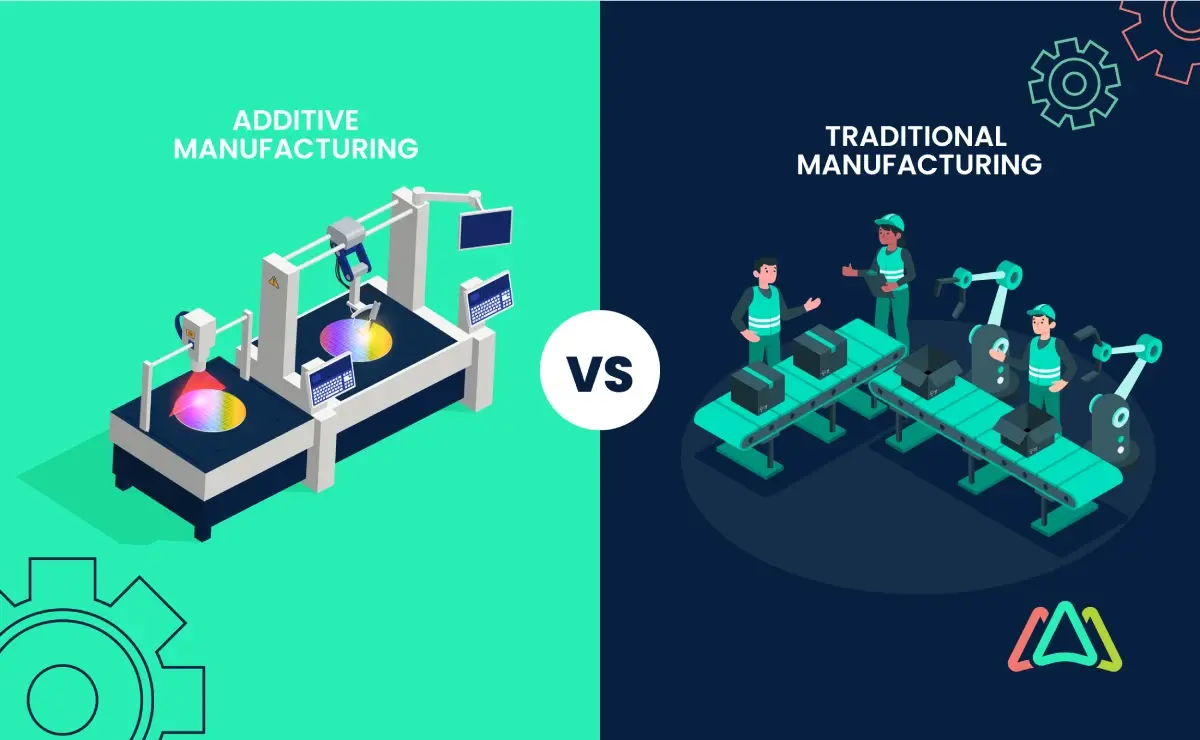
This is where the comparison between additive and traditional manufacturing becomes useful. Additive manufacturing advantages are often strongest when businesses need flexibility, customisation or smaller production runs. Traditional manufacturing, meanwhile, can remain highly effective when designs are stable and production volumes are high.
The right choice depends on what the business actually needs to produce, how often it needs to produce it and how much flexibility the process needs to allow.
Additive Manufacturing vs. Traditional Manufacturing: What Is the Business Difference?
Additive manufacturing creates parts directly from digital designs, while traditional manufacturing uses established processes such as machining and injection moulding.
From a business perspective, the main difference comes down to volume, tooling, flexibility and upfront costs.
With additive manufacturing, businesses can often produce prototypes, customised parts and smaller batches without investing in dedicated tooling. Traditional manufacturing can be more economical when a stable design needs to be produced in large quantities.
Tooling
- Additive Manufacturing: Often little or none
- Traditional Manufacturing: May require dedicated tooling
Small Batches
- Additive Manufacturing: Generally well suited
- Traditional Manufacturing: Can have higher setup costs
Large Volumes
- Additive Manufacturing: May become less economical
- Traditional Manufacturing: Often benefits from economies of scale
Design Changes
- Additive Manufacturing: Easier to update digitally
- Traditional Manufacturing: May require tooling changes
Customisation
- Additive Manufacturing: Flexible
- Traditional Manufacturing: Can add cost or complexity
The right choice depends on the product, quantity and stage of development. There isn’t one manufacturing method that works best for every business.
Where Additive Manufacturing Can Reduce Upfront Costs
One of the biggest financial considerations in manufacturing is what needs to happen before the first production part is made.
Depending on the traditional process being used, a manufacturer may need moulds, dies, fixtures or other dedicated tooling. These can represent a significant upfront investment.
Additive manufacturing can reduce this requirement for suitable applications because the production process can work directly from a digital model.
This can be particularly useful when:
- A product is still being developed
- The design may change several times
- Production quantities are relatively small
- A specialised component is required
- Demand is difficult to predict
- Investing in dedicated tooling would not be practical
This is the basic idea behind tooling free manufacturing. It does not mean that additive manufacturing has no production costs. Materials, machine time, finishing, inspection and other processes still need to be considered.
The difference is that a business may be able to avoid making a large tooling investment before it knows whether the final design or production quantity will justify it.
Manufacturing Cost Comparison: Why Volume Matters
Production volume can change the economics of almost any manufacturing decision.
For a small batch, a large tooling investment can make each part considerably more expensive. As the number of units increases, however, that same tooling cost can be spread across more parts.
This is why a useful manufacturing cost comparison needs to look beyond the price of one component.
Tooling
- Additive Manufacturing: Often minimal or unnecessary for suitable processes
- Traditional Manufacturing: May require dedicated tooling
Production Runs
- Additive Manufacturing: Often practical
- Traditional Manufacturing: Tooling can increase initial costs
Production Volumes
- Additive Manufacturing: May not always be the most economical option
- Traditional Manufacturing: Often benefits from economies of scale
Design Changes
- Additive Manufacturing: Generally easier to implement digitally
- Traditional Manufacturing: May require tooling or process changes
Customisation
- Additive Manufacturing: Highly flexible
- Traditional Manufacturing: Can become more complex
Prototyping
- Additive Manufacturing: Well suited to rapid iterations
- Traditional Manufacturing: Can require additional setup
When Traditional Manufacturing Can Still Be More Cost-Effective
It would be misleading to suggest that additive manufacturing is always cheaper.
Traditional processes can make excellent business sense when a product has already been tested, the design is unlikely to change and production volumes are high.
For example, injection moulding can produce large quantities of identical parts efficiently once the required tooling is in place.
Traditional manufacturing may therefore be preferable when:
- Production volumes are consistently high
- The design is already established
- Large quantities of identical parts are required
- Tooling costs can be spread across many units
- Existing production infrastructure is already in place
- Consistent high-volume production is the main priority
This is where traditional manufacturing cost needs to be viewed in context. A mould may be expensive to create, but that initial cost can become much less significant when it is used to produce a large number of parts.
3D Printing vs. Injection Molding: Which Makes More Business Sense?
The 3D printing vs injection molding discussion is a good example of why manufacturing decisions cannot be reduced to a simple winner.
For prototypes and smaller quantities, 3D printing can offer a more flexible route because there may be no need to create production moulds before testing the design.
As Pir Arkam, Founder & CEO of Proto21, notes:
“Prototypes that used to cost thousands of dollars and days to produce can now be done overnight at a lower cost.”
The statement reflects one of the strongest business cases for additive manufacturing: getting physical versions of a design without committing to the same tooling process required for conventional production.
But the situation changes when production moves into much larger volumes.
Injection moulding can become more practical when a business needs a very large number of identical parts and the design has already been finalised. The cost of the tooling can then be distributed across the production run.
A simple way to think about it is:
Small volume + frequent changes → additive manufacturing may make more sense
Large volume + stable design → injection moulding may make more sense
The exact decision still depends on the part, material, tolerances, complexity and production requirements.
How Additive Manufacturing Changes Product Development Costs
Manufacturing costs do not begin when a final product enters production.
There is also the cost of getting the design right.
A product may go through several versions before the final design is approved. Each version may need to be physically tested, reviewed and modified.
Additive manufacturing can make this process more flexible because a revised digital model can be prepared for another print without necessarily requiring new tooling for every iteration.
This can support:
- Faster physical prototyping
- Earlier design evaluation
- More design iterations
- Easier customisation
- Physical testing before final production
- Reduced commitment to tooling during early development
That does not mean every prototype will be inexpensive or that every design should be 3D printed. It means businesses have another option when they need to make and evaluate physical parts before committing to a larger production method.
Additive Manufacturing Benefits for Custom and Low-Volume Production
Some products simply do not fit neatly into a high-volume manufacturing model.
A company may need a replacement part that is no longer produced. Another business may be developing a niche product with uncertain demand. A manufacturer might need several customised components rather than thousands of identical ones.
These are situations where additive manufacturing benefits can become particularly relevant.
Potential applications include:
- Customised components
- Spare parts
- Limited production runs
- Product prototypes
- Niche products
- Complex geometries
- Replacement parts
- Small batches
Instead of producing a large quantity and storing it, businesses can consider producing smaller quantities when they are actually required, where the application and economics make sense.
That flexibility can be particularly useful when demand is difficult to forecast.
How Additive Manufacturing Supports More Flexible Production
One of the defining characteristics of additive manufacturing is its connection to digital design.
A simplified production workflow looks like this:
Digital design → production preparation → additive manufacturing → finishing → inspection
Once the appropriate digital model is available, a business can make design changes and prepare a revised version without necessarily changing physical tooling.
This can support additive manufacturing production when businesses need to respond to changing requirements.
For example, a product team might discover that a component needs a slightly different shape during testing. Instead of redesigning a mould, the team can modify the digital model and produce another version using an appropriate additive process.
That can make the technology useful during product development and low-volume production, particularly when flexibility matters as much as unit price.
The Hidden Costs Businesses Should Consider
Looking only at the machine or production cost can give an incomplete picture.
A proper manufacturing decision may need to account for:
- Tooling
- Material
- Machine time
- Labour
- Post-processing
- Quality inspection
- Setup
- Inventory
- Storage
- Shipping
- Design changes
- Production volume
For example, a 3D printed component may have a higher cost per unit than a moulded component when production reaches a certain volume. But if the mould requires a significant upfront investment and the product only needs a few hundred units, the overall calculation may look very different.
The same applies to development.
If a design is likely to change several times, committing to production tooling too early can create additional costs when those changes arrive.
The best manufacturing cost comparison therefore considers the complete lifecycle of the product rather than one production number in isolation.
Choosing the Right Manufacturing Method for Your Business
There is no universal formula for choosing between additive and traditional manufacturing.
However, some general patterns can help guide the initial conversation.
Additive Manufacturing May Be a Good Fit When:
- Production quantities are relatively small
- Designs are still changing
- Customisation is important
- Tooling investment is difficult to justify
- A physical prototype is needed quickly
- Demand is uncertain
- Complex geometry is part of the design
Traditional Manufacturing May Be a Better Fit When:
- Production volumes are consistently high
- The design is already stable
- Large quantities of identical parts are required
- Tooling costs can be spread across many units
- Existing production infrastructure is efficient
- Highly repetitive production is the priority
There can also be a third option: use both.
A business might use additive manufacturing during concept development and prototyping, then move to injection moulding or another traditional process once the design is finalised and production volumes justify the change.
That approach allows each manufacturing method to do what it does best.
Where an Additive Manufacturing Company in Dubai Fits Into the Picture
For businesses exploring additive manufacturing, working with an additive manufacturing company in Dubai can provide access to different technologies without requiring the company to build its own production setup.
The right partner can help businesses assess factors such as:
- Production quantity
- Part size
- Material
- Application
- Required finish
- Timeline
- Design complexity
This allows the manufacturing approach to be considered around the actual requirements of the project rather than choosing a technology first and trying to make the project fit around it.
The Business Case for Additive Manufacturing Is About More Than Unit Cost
A manufacturing decision should not come down to the question, “How much does one part cost?”
The better question is:
What does it cost to get the right part, in the right quantity, at the right stage of the product lifecycle?
That means considering:
Tooling + development + production + inventory + lead time + flexibility + expected volume
Sometimes traditional manufacturing will come out ahead.
Sometimes additive manufacturing will.
And in many product development workflows, the most practical approach is to use both at different stages.
Conclusion: Choosing the Process That Fits the Business
The strongest case for additive manufacturing is not that it replaces traditional manufacturing. It is that it gives businesses another way to approach production when flexibility, customisation, design changes or lower volumes matter.
Traditional manufacturing remains highly effective for established products and high-volume production, while additive manufacturing can offer advantages during prototyping, product development and smaller production runs.
The right decision comes down to the product, the volume, the timeline and the overall economics.
For businesses considering additive manufacturing for business, Proto21 can help assess suitable 3D printing approaches for prototypes, customised components and low-volume production based on the requirements of the project.
Frequently Asked Questions
1. Is additive manufacturing cheaper than traditional manufacturing?
Not in every situation. Additive manufacturing can be cost-effective for prototypes, customised parts and smaller production runs, while traditional methods can become more economical at higher volumes.
2. When does 3D printing make more sense than injection moulding?
It can make more sense when quantities are relatively small, the design is still changing or creating dedicated tooling would add unnecessary upfront cost.
3. Does additive manufacturing require tooling?
Many additive manufacturing processes can produce parts directly from digital designs without dedicated production moulds. However, the overall process may still involve setup, finishing and inspection.
4. Is additive manufacturing suitable for high-volume production?
It can be used for production, but whether it makes financial sense depends on the quantity, part design, material and required production rate. Traditional methods may be more economical for very high volumes of identical parts.
5. What should a business include in a manufacturing cost comparison?
Look beyond the unit price. Tooling, materials, machine time, labour, finishing, quality control, storage, inventory, shipping and future design changes can all affect the overall cost.
6. Why is additive manufacturing useful for small production runs?
It can reduce the need for dedicated tooling and allows businesses to produce parts directly from digital designs. That can make smaller quantities more practical for suitable applications.
7. Can additive manufacturing reduce product development costs?
It can, particularly when a product needs several physical prototypes or design iterations. Businesses can modify the digital design and produce another version without necessarily creating new production tooling each time.
8. What are the main additive manufacturing benefits for businesses?
Common benefits include design flexibility, customisation, rapid prototyping and suitability for low-volume production. The actual benefits depend on the application and manufacturing requirements.
9. Can additive and traditional manufacturing be used together?
Yes. A business may use 3D printing for prototypes and early production, then move to injection moulding or another traditional process once the design is stable and production volumes increase.
10. How should a company choose between additive and traditional manufacturing?
Start with the requirements rather than the technology. Consider the production volume, design stability, material, part complexity, timeline, tooling requirements and total cost before choosing a manufacturing process.