

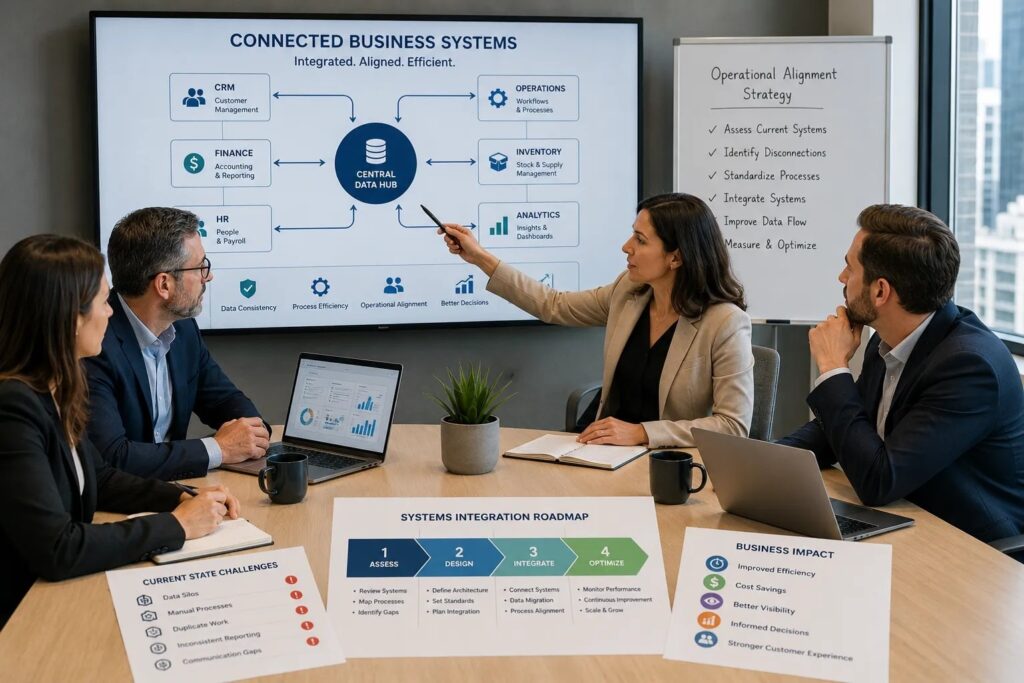
As businesses grow, they naturally adopt new software to support sales, finance, operations, customer service, and project management. Each system may solve a specific problem, but over time these individual solutions can become disconnected from one another. Information is stored in separate places, workflows become fragmented, and employees spend more time moving data than using it.
Many organizations assume these inefficiencies stem from outdated software or inconsistent employee performance. In reality, the underlying issue is often a lack of alignment between business systems. Before investing in additional automation or artificial intelligence, organizations should first understand how their existing systems work together and where operational gaps exist.
Hidden Costs Extend Beyond Software Expenses
The financial impact of disconnected systems is rarely reflected in software licensing costs alone. The greater expense often comes from the time employees spend compensating for systems that do not communicate effectively.
For example, customer information may need to be entered into multiple applications. Reports may require data from several departments before leadership can make decisions. Teams may rely on spreadsheets or email to bridge gaps between platforms that were never designed to work together.
These manual processes increase administrative workload while introducing opportunities for errors and inconsistencies. As the business grows, these inefficiencies become more difficult to manage and increasingly expensive to maintain.
Improving operational efficiency often begins with reducing these hidden costs rather than purchasing additional technology.
Fragmented Systems Create Operational Bottlenecks
Disconnected systems rarely affect only one department. A delay in one part of the organization can create ripple effects across multiple teams.
Sales may close new business before operations has access to complete customer information. Finance may wait for manual updates before invoicing. Customer service may work from outdated records because information is stored in another application.
These gaps slow decision-making, increase response times, and make it more difficult for leadership to maintain visibility across the business.
Business systems integration is not simply about connecting software. It is about ensuring information flows consistently between people, processes, and departments so work can move forward without unnecessary delays.
Process Improvement Starts With System Alignment
When businesses encounter operational challenges, the instinct is often to replace software or introduce new technology. While modern platforms can provide significant benefits, they cannot resolve inefficient processes on their own.
Organizations first need to understand how work moves through the business. Which systems support critical operations? Where does information stop flowing? Which manual tasks exist only because systems are disconnected?
Answering these questions creates a stronger foundation for business process improvement. Instead of addressing individual symptoms, leaders can identify the operational issues affecting multiple departments and prioritize improvements that deliver lasting value.
This systems-first approach also helps ensure future technology investments support established business objectives rather than creating additional complexity.
Better Systems Support Smarter Technology Investments
Automation and AI continue to attract significant attention, but both depend on reliable business processes and accurate information.
If existing systems contain duplicate records, inconsistent workflows, or disconnected data, automation can simply accelerate inefficient processes instead of improving them. Likewise, AI initiatives are only as effective as the quality of the information they receive.
Before expanding into automation or advanced technologies, many organizations benefit from evaluating how their current systems support daily operations. Firms such as Convex AI Systems provide a business systems consulting approach that helps organizations assess existing systems, identify operational disconnects, and create implementation roadmaps before introducing automation or AI initiatives.
This planning process allows businesses to make technology decisions that reinforce operational goals rather than adding another disconnected platform to an already complex environment.
Building an Operational Strategy for Long-Term Growth
Operational excellence depends on more than selecting the right software. It requires systems that support collaboration, consistent workflows, and informed decision-making across the organization.
An effective systems strategy considers how departments interact, how information moves between teams, and where standardization can improve organizational efficiency. It also creates a framework for future growth by reducing reliance on manual workarounds and fragmented processes.
Operational consulting can play an important role in this effort by helping leaders evaluate current workflows, identify opportunities for alignment, and prioritize improvements that produce measurable business outcomes.
As organizations continue to grow, connected systems become increasingly important. Businesses that invest in operational alignment before introducing additional technologies are often better positioned to improve productivity, support employees, and scale efficiently.
Rather than asking whether another software platform will solve operational challenges, business leaders should first determine whether their existing systems are working together effectively. Addressing those foundational issues creates a stronger platform for sustainable growth, better decision-making, and future innovation.