

The landscape of legal research has undergone a seismic shift. Gone are the days when “digital research” simply meant searching a static database of case law. In 2026, the volume of data—ranging from global regulatory updates to decentralized finance (DeFi) precedents—is overwhelming. For legal professionals and law students alike, the challenge isn’t just finding information; it’s synthesizing complex data into actionable legal strategies.
Efficiency is no longer an advantage; it is a survival trait. As courts integrate AI-driven docketing and predictive sentencing models, researchers must leverage a sophisticated tech stack to remain competitive. Whether you are drafting a high-stakes corporate brief or navigating the intricacies of international human rights law, your output is only as good as the tools you use to manage your cognitive load.
Navigating these complexities requires more than just software; it requires a structured approach to academic and professional rigor. For students struggling to balance these emerging technologies with rigorous university standards, seeking expert guidance can be a game-changer. Utilizing specialized law assignment help allows researchers to understand how to apply these high-level tools to specific case studies, ensuring that theoretical knowledge meets practical application in a way that satisfies both professors and future partners.
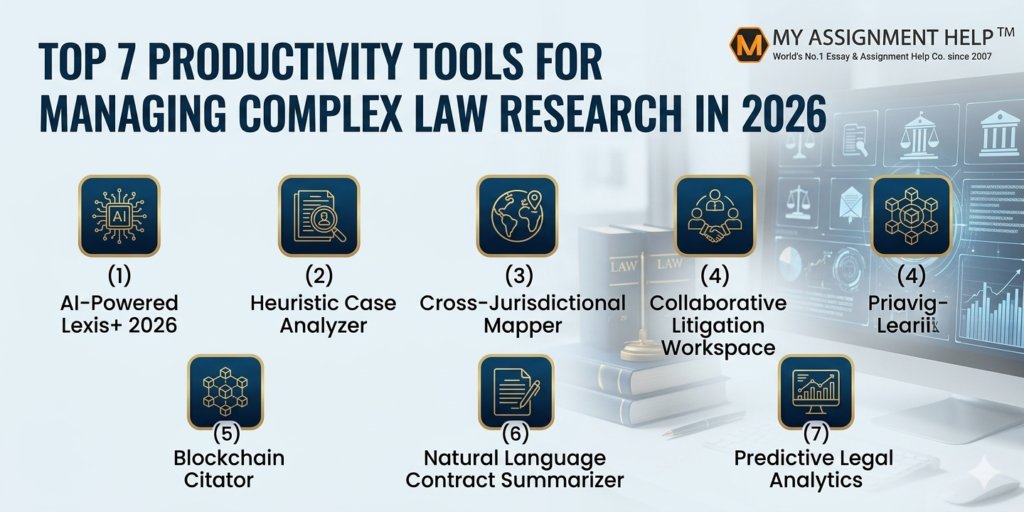
Here are the top 7 productivity tools redefining law research in 2026.
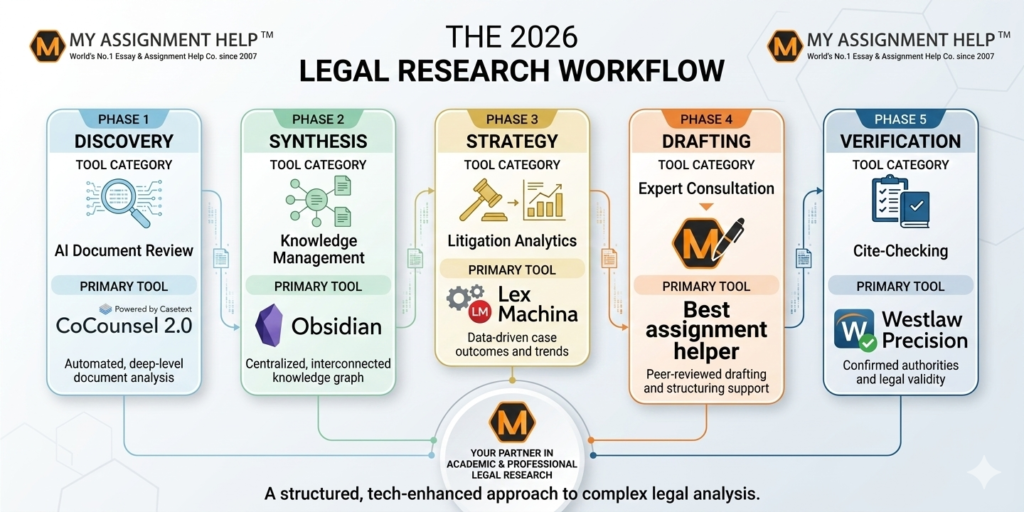
1. CoCounsel 2.0 (by Casetext)
CoCounsel remains the gold standard for AI-driven legal assistants. In 2026, its “Deep Research” mode allows users to upload thousands of discovery documents and receive a verified memo in minutes.
- Why it’s essential: It uses specialized Large Language Models (LLMs) trained exclusively on law, eliminating the “hallucination” risks associated with general-purpose AI.
- Data Point: According to a 2025 ABA Legal Technology Survey, firms using AI-assisted research reported a 40% reduction in billable hours spent on initial document review.
2. Westlaw Precision with Generative AI
Thomson Reuters has evolved Westlaw into a predictive powerhouse. The 2026 “Precision” suite doesn’t just find cases; it maps the “trajectory of the law.” It uses historical data to predict how a specific judge might rule based on current legal trends.
- Key Feature: “Research Outline” automatically builds a chronological history of a legal principle across different jurisdictions.
3. Obsidian (with Legal Plugin Architecture)
While not a legal tool by birth, Obsidian has become the go-to “second brain” for lawyers. Its “graph view” allows researchers to see visual connections between different statutes and case citations.
- The 2026 Edge: New community plugins specifically for Bluebook formatting and PACER integration make it the ultimate repository for complex note-taking.
4. LiquidText
For those who miss the tactile feel of highlighting paper, LiquidText on tablets is the solution. It allows you to “scrunch” a 200-page document to compare two distant paragraphs side-by-side.
- Integration: In 2026, it syncs directly with cloud-based case management systems, allowing you to pull evidence directly into your active workspace.
5. Lex Machina (Legal Analytics)
Research is no longer just about the law; it’s about the players. Lex Machina provides “Legal Analytics” that allow you to research the opposing counsel’s track record, the judge’s tendencies, and the parties involved.
- Source: Recent McKinsey reports suggest that data-driven litigation strategy increases the likelihood of favorable settlements by 15%.
6. Heuristica
This is an emerging favorite for 2026. Heuristica is a visual knowledge-mapping tool that helps researchers break down complex legal concepts into hierarchical “concept maps.” It is particularly useful for law students trying to visualize the relationship between different branches of administrative law.
7. Otter.ai for Counsel
In 2026, deposition and interview research are streamlined via Otter.ai’s specialized legal encryption. It provides real-time transcription with “Auto-Summary” features that tag specific legal keywords and mentions of statutory codes, making oral testimony as searchable as a PDF.
Key Takeaways
- AI is a Partner, Not a Replacement: Tools like CoCounsel 2.0 handle the “grunt work,” allowing human lawyers to focus on high-level strategy.
- Visualizing Law: Tools like LiquidText and Heuristica are essential for managing the sheer volume of modern legal data.
- Data-Driven Decisions: Successful litigation in 2026 relies on analytics (Lex Machina) rather than just intuition.
- Academic Support: Professional services remain vital for bridging the gap between classroom theory and the fast-paced tech reality of modern firms.
Frequently Asked Questions (FAQ)
Q1: Will AI tools replace law researchers by 2027?
A: No. While AI automates data retrieval, the “legal mind”—the ability to apply ethical reasoning, empathy, and nuanced strategy—remains uniquely human.
Q2: Are these tools affordable for law students?
A: Many offer “Student Editions.” However, for comprehensive support on complex projects, many students find that hiring a professional service or the best assignment helper is more cost-effective than multiple premium subscriptions.
Q3: How do I ensure my AI-assisted research is “hallucination-free”?
A: Always use tools like Westlaw or Casetext that use “Retrieval-Augmented Generation” (RAG). This ensures the AI only draws answers from a verified, closed database of real laws.
Q4: Is Obsidian hard to learn for non-techy lawyers?
A: There is a learning curve, but the “Legal Brain” templates available online in 2026 make it much more accessible for beginners.
About the Author: Sarah Jenkins
Sarah Jenkins is a Senior Academic Consultant at MyAssignmentHelp. With over 12 years of experience in legal writing and a J.D. from a Top-Tier US Law School, Sarah specializes in the intersection of legal technology and pedagogy. She has helped thousands of students navigate the complexities of modern jurisprudence by integrating traditional research methods with cutting-edge digital tools. When she isn’t auditing the latest legal software, she contributes to journals on the ethics of AI in the courtroom.
References
- American Bar Association (ABA) – 2025 Legal Technology Survey Report.
- Stanford Center for Legal Informatics (CodeX) – The Evolution of RAG in Legal LLMs (2026).
- Thomson Reuters – The State of the Legal Professional Report 2026.
- McKinsey & Company – The Economic Potential of Generative AI in Professional Services.
